
File Formats#
CoMSA produces files using block compression. The content of the compressed file varies based on the format of the original file.
FASTA#
FASTA files contains a single compressed block, without additional metadata such as the compressed block size. FASTA files contain only a single MSA, and cannot be concatenated.
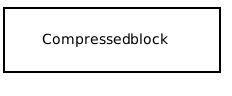
The sequences are compressed using a combination of pBWT, WFC, RLE and Range Coder; the rest of the text (the sequence names) is compressed with LZMA.
Stockholm#
Stockholm files sequences of compressed blocks, preceded by the length of each blocks, and terminated by a footer.
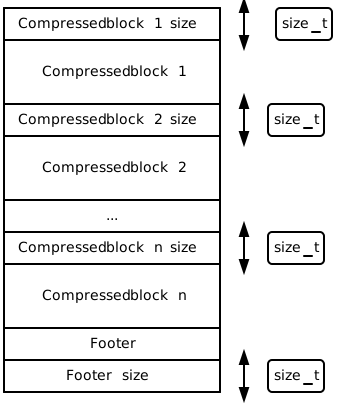
The footer contains extra metadata for each MSA: the name and accession of the full MSA, the compressed and decompressed size, and a pointer in the file allowing random access.
Caution
Because the footer size are encoded as size_t integers with native
byte ordering, the Stockholm files are inherently not portable, and a
file made on a platform (e.g. x86-64) may not be readable transparently
on another platform (e.g armv7l).
pycomsa attempts a few checks before loading data, but since CoMSA
doesn’t emit files with magic bytes, it is not possible to automatically
detect the format of each file. To mitigate this, the open function
and the StockholmReader and StockholmWriter types
support a size_format parameter, as a struct format character, which
allows controlling at runtime in which format the block and footer size
are loaded.
For example, the following format always creates files that are using 64-bit little-order endianess for compatibility across platforms:
>>> with pycomsa.open("output.msac", "w", size_format="<Q") as f:
...     f.write(msa)